Eindhoven Center for the Philosophy of Artificial Intelligence
The Eindhoven Center for the Philosophy of Artificial Intelligence (ECPAI) advances the understanding of philosophical issues in AI and investigates the ethical and social implications of AI technology through philosophical reflection. Its members, mostly comprised of researchers in the Philosophy & Ethics Group at Eindhoven University of Technology, contribute to interdisciplinary AI research and engage with industry, policy, and civil society actors to ensure the responsible development and use of AI.
Our AI Clusters
Investigating Minds: From Animals to AI
Exploring the relation of AI, Creativity, and Human Well-Being
Understanding AI through insights from human cognition, psychology and neuroscience
Philosophical and Ethical Perspectives on AI and Health
Investigating the relation of Responsibility, Meaningful Human Control and Justice in the context of AI
Events and News

Postdoc In Philosophy of Technology
Are you excited to co-create, together with non-academic stakeholders, a transdisciplinary framework that synthesizes ethical theories of human flourishing with system thinking approaches into a notion of sociotechnical system flourishing? Are you eager to connect diverse philosophical perspectives to tackle urgent challenges in the ethics of socially disruptive technologies?
Course on Creative Work and Artificial Intelligence
We’re happy to share that two colleagues recently taught a course on AI and creativity with great success, bringing fresh perspectives on the role of human creativity in the age of AI.

ECPAI Research Day 2026
Eindhoven Center for the Philosophy of AI Research Day 2026 On 27 January 2026, we hosted our internal ECPAI Research Day, bringing together colleagues from Philosophy & Ethics, along with collaborators and external guests, for an afternoon of exchange and collaboration.

Philosophy & Ethics of Creative AI: Seed Funding Event
The Philosophy & Ethics of Creative AI: Seed Funding Event for Early Career Researchers ECPAI member Matthew Dennis co-orgnises together with James Pearson, postdoctoral researcher in Political Science at the University of Amsterdam and in Philosophy at the University of Lisbon, an event to introduce researchers to funding schemes that can support cutting-edge research on how artificial intelligence is changing how we understand creativity.

Justice, Power, and Control in Medical AI Symposium
Symposium Announcement: Justice, Power, and Control in Medical AI As part of the 3rd International Conference on Decision Making in Medicine and Law: Opportunities and pitfalls of information technologies(DMM&L 2025) conference, we are happy to announce the symposium ‘Justice, Power, and Control in Medical AI’, which will take place on Friday,12.
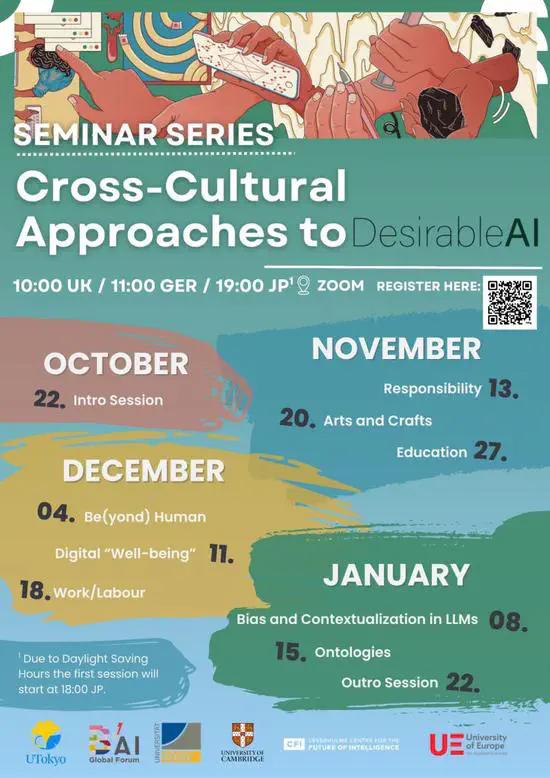
Seminar Digital Well-Being
Seminar on Digital Well-Being As part of the ongoing seminar “Cross-Cultural Approaches to Desirable AI”, we are pleased to announce the digital well-being session, which will take place on 11 December 2025.

Congratulations on the successful PhD defense Céline Budding!
We are pleased to congratulate our colleague Céline Budding for successfully completing her PhD thesis, “What do language models know when they know language? A theoretical framework for explaining the linguistic behavior of LLMs”.
Workshop - AI, reasoning, and explanation
AI, including AI agents and LLMs, purports to reason and offers reasoning to explain and justify judgment and decision. In assessing this reasoning, what are the most useful or essential frames and frameworks to develop and apply?

Call for Papers - Artificial Intelligence in Research & Education
We are pleased to announce the Call for Papers for the AI in Research & Education unit, part of the Oxford Intersections: AI & Society series published by Oxford University Press.
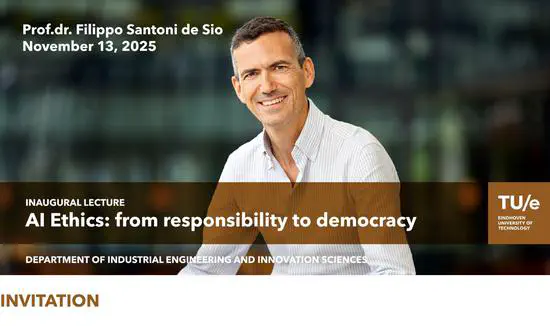
AI Ethics - from Responsibility to Democracy, Inaugural Lecture Prof. Dr. Filippo Santoni de Sio
ECPAI Member Prof.dr. Filippo Santoni de Sio was appointed as a full-time professor of Ethics of Technology at the Department of Industrial Engineering and Innovation Sciences at Eindhoven University of Technology (TU/e) on September 1, 2024.